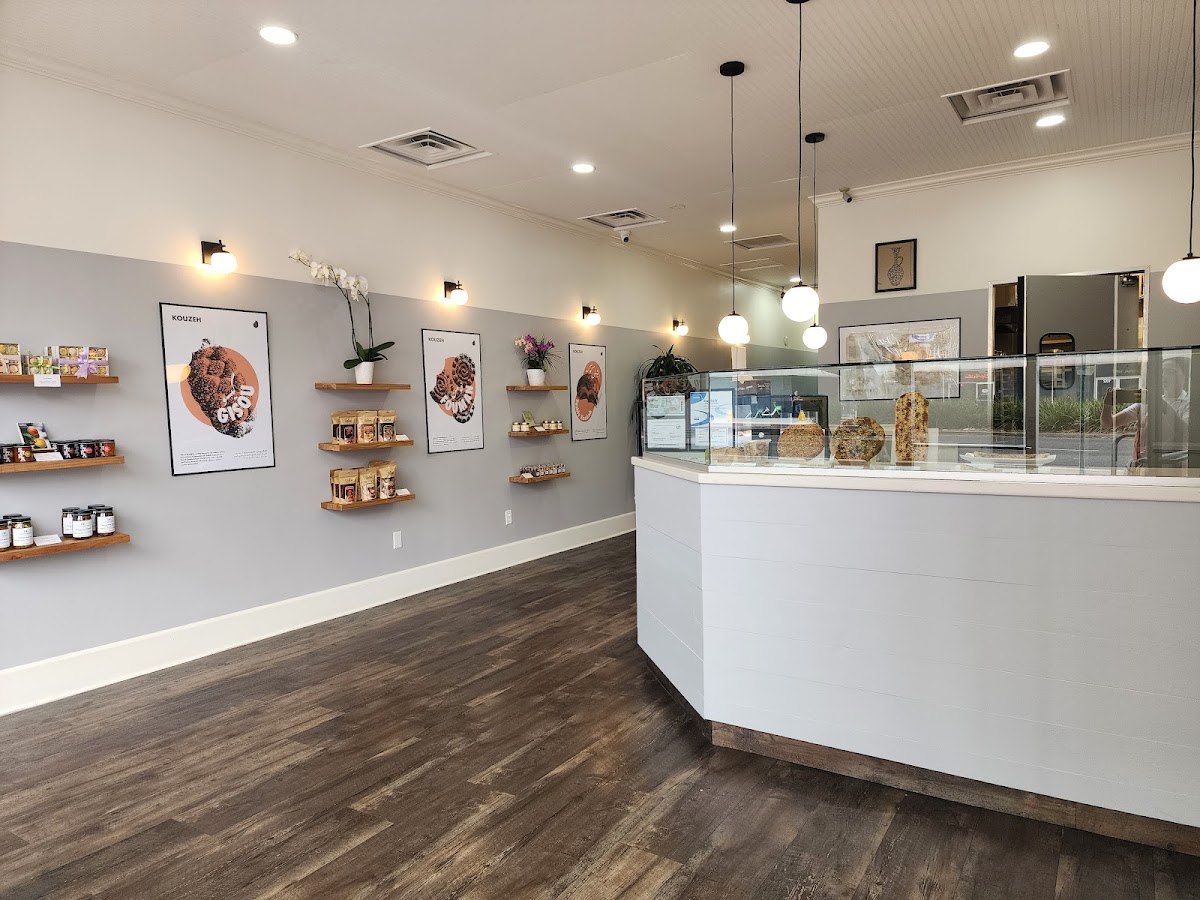
For nearly a decade, Sahar Shomali has been the person you'd hunt down at the farmers' market if you wanted real Persian bread—the kind made with proper fermentation, regional specificity, and the kind of technical precision that only comes from years spent in professional kitchens. Before launching Kouzeh as a cottage operation in 2018, Shomali worked as a pastry chef at Spago, Lucques, and Hearth & Hound, institutions where she learned the unforgiving language of precision baking. That expertise is now on full display at Kouzeh's first brick-and-mortar location on Wilshire Boulevard, which opened in May 2026.
Southern California is home to many Persian bakeries, but none of them dive as deeply into the wonderful world of Iranian baked goods as Kouzeh. The shop's display case holds nearly two dozen breads representing different regions and traditions across Iran—each one a small thesis on local ingredients, climate, and baking philosophy. There's the barbari, that sturdy, seed-studded workhorse. The latir flatbread, studded with dill, cumin, and sesame seeds. The ghelefi, a potato-filled bread that achieves an almost impossible balance between crisp exterior and tender crumb. These aren't novelties or Instagram plays. They're honest breads, made with long fermentation and the kind of attention that suggests Shomali views each loaf as a conversation with Iranian baking tradition.
LA Times critic Bill Addison has already called Kouzeh "L.A.'s next great bakery," and it's hard to argue with the assessment. There's something unmistakably different about walking into a space where the baker has spent years studying regional variations rather than chasing trends. The gisou—a braided brioche-like bread that requires real technical skill—sits alongside the fouman spiced cookies, each item reflecting genuine knowledge rather than guesswork.
This matters now because Los Angeles has grown accustomed to excellent bread, but excellent *regional* bread—bread that honors specific traditions and doesn't apologize for complexity—is still rare. Shomali's willingness to spend eight years building a following through farmers' markets before opening a permanent space suggests someone not interested in shortcuts. The brick-and-mortar location isn't a scaling operation. It's a validation of what she's been doing all along.